

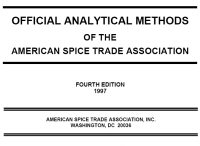
 The Official Analytical Methods of the American Spice Trade Association provide the industry standard for analytical testing of spices. This 8 1/2 ” x 11″ hard cover, loose leaf binder includes all previous existing ASTA methods, revised and updated, as well new methods. References and statistical data are inserted. Members can download individual methods for free.
($50.00 for Members, $125.00 for US Non-Members, $150.00 for International Non-Members)
Proceed to Online Ordering – If you are a member, please login as a member to receive the member rate
TABLE OF CONTENTS
| Method | General Method | Page |
| 1.0 | Preparation of Sample (Revised July 2012) | 1 |
| 2.0 | Moisture (Distillation Method) (Revised July 2011) | 2 |
| 2.1 | Moisture in Spices (Vacuum Oven Method) (Revised January 1997) | 6 |
| 3.0 | Total Ash (Revised January 1997) | 11 |
| 4.0 | Acid Insoluble Ash (Revised January 1997) | 15 |
| 5.0 | Steam Volatile Oil (Modified Clevenger Method) (Revised March 2010) | 17 |
| 5.1 | Steam Volatile Oil (Lee and Ogg Method) (Revised March 2010) | 23 |
| 5.2 | Steam Volatile Oil in Spices (Revised March 2010) | 29 |
| 6.0 | Water Activity (October 2010, Original Version) | 1-6 |
| 7.0 | Crude Fiber (Revised January 1997) | 35 |
| 8.0 | Starch (Direct Acid Hydrolysis) (Revised January 1997) | 39 |
| 9.0 | Alcohol Extract (Revised January 1997) | 43 |
| 10.0 | Sieve Analysis (Revised October 2004) | 45 |
| 11.0 | Non-Volatile Methylene Chloride Extract (Revised January 1997) | 49 |
| Method | Methods for Specific Spices | Page |
| 12.1 | Piperine Content of Black and White Pepper, Their Oleoresins and Soluble Pepper Seasonings (Revised August 2022) | 51 |
| 14.0 | Mold and Extraneous Matter in Black and White Pepper (Revised January 2013) | 55 |
| 14.2 | Light Berries in Black and White pepper (Revised January 2013) | 57 |
| 14.1 | Extraneous Matter in Spices (Excluding Pepper) (Revised April 2014) | 59 |
| 15.0 | Volatile Oil in Mustard Seed and Flour (Revised January 1997) | 67 |
| 15.1 | Volatile Oil in Mustard Seed and Flour (Alternate Method) (Revised January 1997) | 71 |
| 16.0 | Steam Volatile Oil in Cassia (Revised March 2010) | 75 |
| 17.0 | Cinnamic Aldehyde in Cassia Oils (Revised January 1997) | 81 |
| 18.0 | Curcuminoids Content of Turmeric Spice & Oleoresins (Revised April 2019) | 81 |
| 19.0 | Phenols in Nutmeg and Mace (Revised January 1997) | 85 |
| 20.1 | Extractable Color in Capsicums and Their Oleoresins (Revised October 2004) | 89 |
| 21.2 | Sensory Evaluation of Low Heat Chilies, Red Peppers and Oleoresins (Revised December 1998) | 105 |
| 21.3 | Pungency of Capsicums and Their Oleoresins (HPLC Method – Preferred) (Revised October 2004) | 111 |
| 22.1 | Microanalytical Analysis of Paprika (Revised January 1997) | 115 |
| 22.2 | Microanalytical Analysis of Ground Capsicums (Excluding Paprika) (Revised January 1997) | 119 |
| 23.1 | Ethylene Oxide (EtO) and Ethylene Chlorohydrin Residue in Black Pepper (Revised January 1997) | 123 |
| 23.2 | Determination of Ethylene Oxide (EtO) (Revised January 1997) | 127 |
| 23.3 | Ethylene Chlorohydrin Residue in Spices (Revised January 1997) | 131 |
| 24.0 | Aflatoxin Determination (Revised January 1997) | 137 |
| 24.1 | Aflatoxins in Herbs and Spices (Immunoaffinity Column Method) (Revised December 1998) | 143 |
| 24.2 | Analysis of Aflatoxins B1, B2, G1, and G2 by HPLC (Revised January 1997) | 149 |
| 25.0 | Bulk Index/Bulk Density (Manual Method) (Revised January 2013) | 153 |
| 25.1 | Bulk Index/Bulk Density (Machine Method) (Revised January 2013) | 155 |
| 26.0 | Foreign Leaves in Oregano (Revised October 2010) | 1-7 |
| 26.1 | Screening Method for the Determination of Defatted Meal in Paprika & Black Pepper (Revised October 2004) | 161 |
| 27.0 | Total Hexane Content in Extracted Meals – (Headspace Gas Chromatography Method) (Revised June 2008) | 165 |
| 28.0 | Determination of Oil Soluble Dyes in Capsicum and Turmeric Samples and Products by High Performance Liquid Chromatography (Revised June 2008) | 166 |
| Recommended Microbiological Methods – Preface (Revised October 2004) | 169 | |
| Recommended Microbiological Methods (Revised October 2004) | 171 | |
| 29.0 | Determination of dyes in capsicum and turmeric samples and products by high performance liquid chromatography with MS/MS detection (Revised October 2013) | 173 |
| 30.0 | Determination of Added Sulfites in Dried Allium (Modified Monier-Williams Method) (Revised October 2010) | |
| 31.0 | Analysis of Ochratoxin A in Spices by HPLC (May 2023) | |
| Appendix | 175 |
If you have any questions about these publications, please contact the ASTA office at [email protected].